
日期 | 2025.08.27
Energy efficiency services for industry
作者 | Dept. of Civil Engineering
隸屬單位 | Engineering
聯合國永續發展目標

專案摘要/目標
專案成果
-
The high-temperature operations involved in material production and construction during the hot-mix asphalt concrete paving methods commonly used in current pavement engineering generate greenhouse gas emissions, alongside the surplus and accumulation issues of reclaimed asphalt pavement (RAP) generated after roads are planed and repaved.
-
Dedicated to the service quality of road engineering for many years—ranging from road material selection, the construction phase, to post-construction surveys and performance evaluations—our team, formed in Dept. of Civil Engineering, National Central University, seized this opportunity to invite the industry at to establish the industry-academia technology alliance: "Industrial Transfer of Advanced Pavement Technology to Net-Zero Emission-Reduction Temperature Alliance".
-
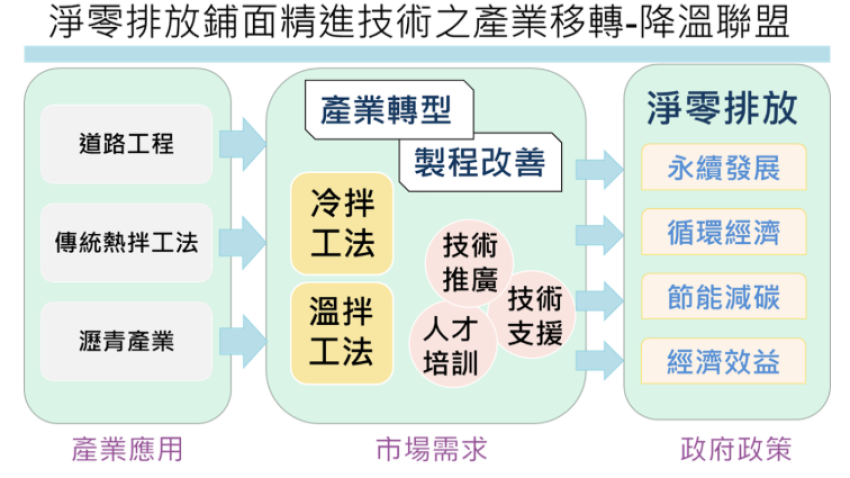
Aligning with the national policy goal of "Net-Zero Emissions," the alliance assist Taiwan’s road engineering industry in achieving "industrial transformation" according to the net-zero emission pathway. Centered around the laboratory's professional knowledge and technology in pavement engineering, we consider three dimensions: materials, energy, and environmental protection.
-
By utilizing cold-mix and warm-mix asphalt technologies—two refinement technologies for net-zero emission pavements—the alliance promote industrial transformation through talent training, technical support, exchanges, and promotion. This increases the production and use of asphalt concrete manufactured via cold-mix and warm-mix technologies, thereby reducing greenhouse gas and air pollution emissions, improving the working environment for paving operations, and aligning with the development of national energy-saving and carbon-reduction policies.
關鍵字
參考資料
聯絡資訊